

Cigarette Tax Hike Under Scrutiny as Industry Flags Risks to Farmers, MSMEs, and Local Jobs
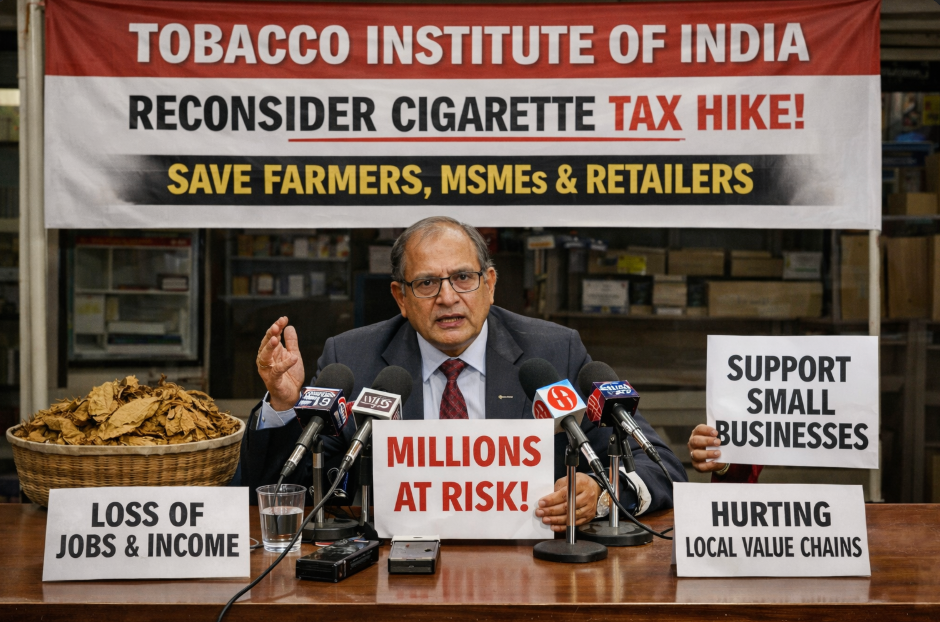
The Tobacco Institute of India has urged the central government to reconsider the recent hike in cigarette taxes, warning that the move could trigger widespread economic stress across the tobacco value chain.
According to the industry body, higher taxation on cigarettes does not just impact large manufacturers. It has direct and indirect consequences for millions of farmers, small traders, MSMEs, retailers, and workers who depend on tobacco related livelihoods.
A large but often overlooked value chain
Tobacco is one of India’s major agri based industries, supporting a complex network that spans farmers, curing units, transporters, processors, small packaging units, wholesalers, and neighbourhood retailers.
India is among the world’s largest producers of tobacco, and a significant share of this production feeds domestic cigarette manufacturing. Any sharp tax increase on the end product can compress demand, slow procurement, and disrupt cash flows across the chain.
Industry representatives argue that when legal cigarette volumes decline, the impact is felt first at the farm gate and then ripples through MSMEs and retail networks.
Concerns around unintended consequences
The Tobacco Institute of India has highlighted that steep tax hikes on cigarettes often lead to unintended outcomes. One of the key risks cited is the growth of illicit and unregulated products, which are untaxed and outside quality and safety controls.
When legal products become significantly more expensive, consumers tend to shift toward cheaper alternatives. This erodes government revenue while weakening compliant businesses that operate within the tax framework.
For small retailers and distributors, reduced volumes in legal cigarette sales can translate into lower margins and reduced viability, especially in semi urban and rural markets.
Impact on farmers and MSMEs
Tobacco farming in India supports millions of livelihoods, many of them in regions with limited crop diversification options. Reduced demand from legal manufacturers can affect procurement volumes, pricing stability, and long term farmer confidence.
MSMEs engaged in leaf processing, packaging, logistics, and allied services are also vulnerable. These enterprises often operate on thin margins and depend on predictable volumes to sustain operations.
Industry voices argue that policy decisions should account for these downstream effects rather than focusing only on the end consumer price.
Balancing revenue and economic stability
Cigarettes are among the highest taxed consumer products in India and contribute significantly to government revenues. However, the industry maintains that excessive taxation can become counterproductive if it shrinks the legal market faster than it raises per unit tax collections.
The Tobacco Institute of India has called for a more balanced approach that protects public revenue while preserving livelihoods and discouraging illicit trade.
A policy debate beyond tobacco
This debate reflects a broader policy challenge. How to balance health objectives, revenue needs, and economic sustainability across complex domestic value chains.
As the government evaluates its next steps, the outcome will have implications not just for tobacco companies, but for millions of farmers, MSMEs, and retailers who form the backbone of this traditional industry.
For policymakers, the question is not just about taxation levels, but about understanding the full economic footprint of the decisions they make.
By Team TNN