

MeitY Clears ₹41,800 Crore Electronics Investments. A Big Signal for India’s Component Manufacturing Push
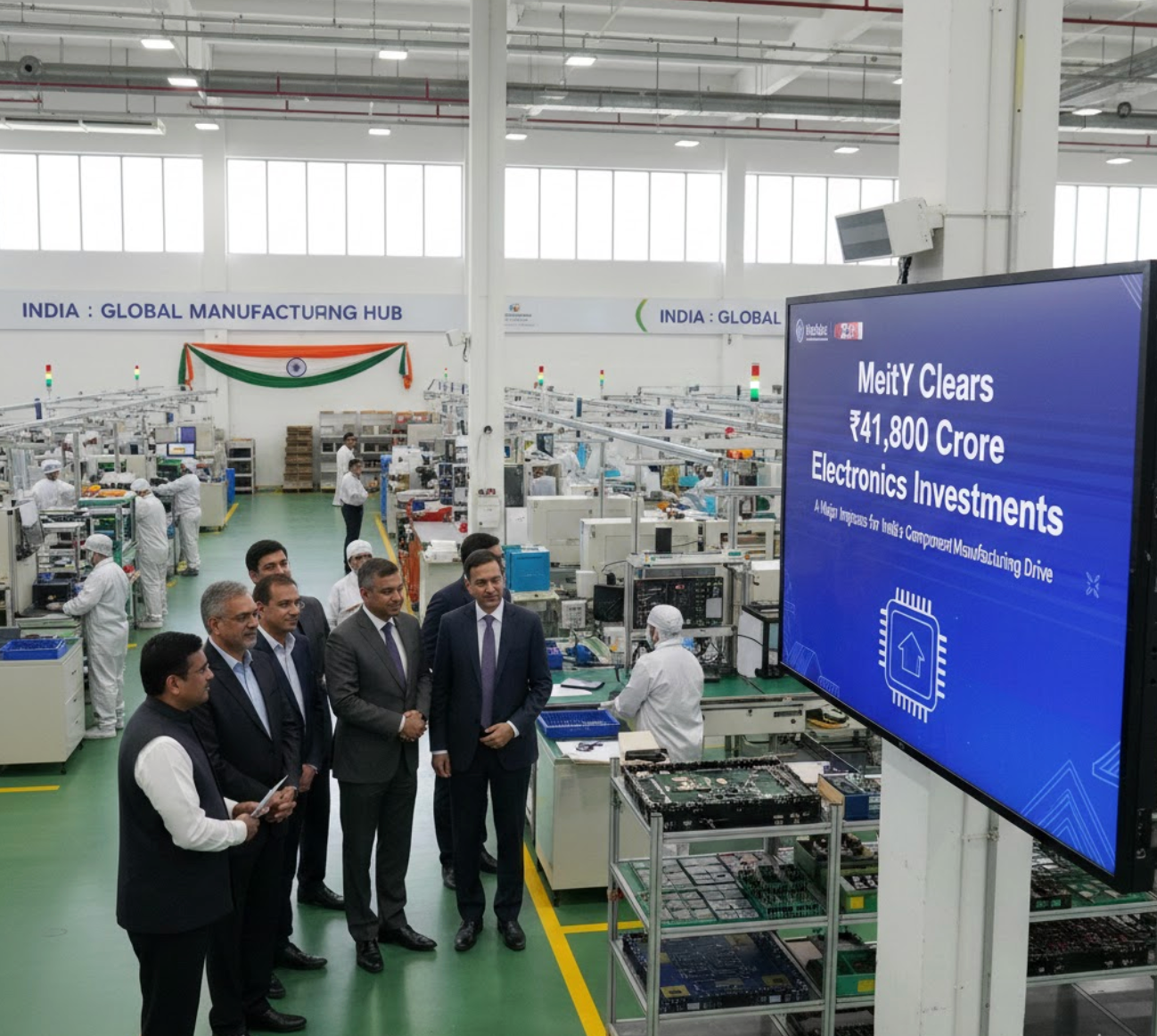
India’s electronics manufacturing push received a major boost as the Ministry of Electronics and Information Technology cleared investment proposals worth nearly ₹41,800 crore under the Electronics Components Manufacturing Scheme.
The approvals are expected to generate close to 34,000 direct jobs, reinforcing the government’s intent to strengthen domestic electronics supply chains and reduce import dependence in critical components.
What has been approved
The latest clearances cover 22 new proposals under the scheme. These projects together carry a projected investment of ₹41,863 crore and are expected to result in production worth approximately ₹2.58 lakh crore over their lifecycle.
Earlier, the ministry had already cleared 24 applications with a combined investment of around ₹12,700 crore in the first two tranches. With the new approvals, the scope and scale of the scheme expands significantly.
Focus on core electronic components
The approved products largely focus on five bare components that form the backbone of electronics manufacturing. These include printed circuit boards, capacitors, connectors, enclosures, and lithium ion cells. In addition, three key sub assemblies such as camera modules, display modules, and optical transceivers are also covered.
These components are currently among the most import dependent segments of India’s electronics ecosystem. Domestic value addition in electronics assemblies is estimated to be around 15 percent today, with critical parts like circuit boards and sub systems still largely sourced from overseas suppliers.
Manufacturing spread across multiple states
The projects will be set up across eight states, including Andhra Pradesh, Haryana, Karnataka, Madhya Pradesh, Maharashtra, Tamil Nadu, Uttar Pradesh, and Rajasthan. This geographic spread signals a broader industrial footprint rather than a single cluster driven approach.
The scheme now covers manufacturing across 11 targeted product segments, spanning mobile phones, telecom equipment, consumer electronics, automotive electronics, IT hardware, and strategic electronics.
Why this matters for India
Electronics is one of India’s fastest growing manufacturing sectors, yet component level dependence has remained a structural weakness. Finished product assembly has scaled rapidly, but upstream components continue to be imported, particularly from East Asia.
By pushing incentives at the component level, the government is attempting to fix this imbalance. Stronger domestic supply chains can lower costs, improve resilience, and support India’s ambition to become a global electronics manufacturing hub.
For MSMEs, suppliers, and contract manufacturers, this opens up long term opportunities in tooling, materials, precision manufacturing, and testing infrastructure. For global firms, it signals policy continuity and deeper ecosystem readiness.
The bigger picture
These approvals come at a time when global electronics supply chains are being reconfigured due to geopolitical risks, rising costs, and the need for diversification. India is positioning itself not just as an assembly destination, but as a serious player across the electronics value chain.
If execution matches intent, this phase of investment could mark a turning point for India’s electronics component manufacturing story.
For India’s manufacturing ecosystem, this is not just about numbers. It is about building capability where it matters most.
By Team TNN