

Skyroot Operationalizes “Infinity Campus”: Inside India’s New Rocket Factory for the 2026 Space Race
By Santosh Sinha | SpaceTech & Innovation Desk Date: November 29, 2025
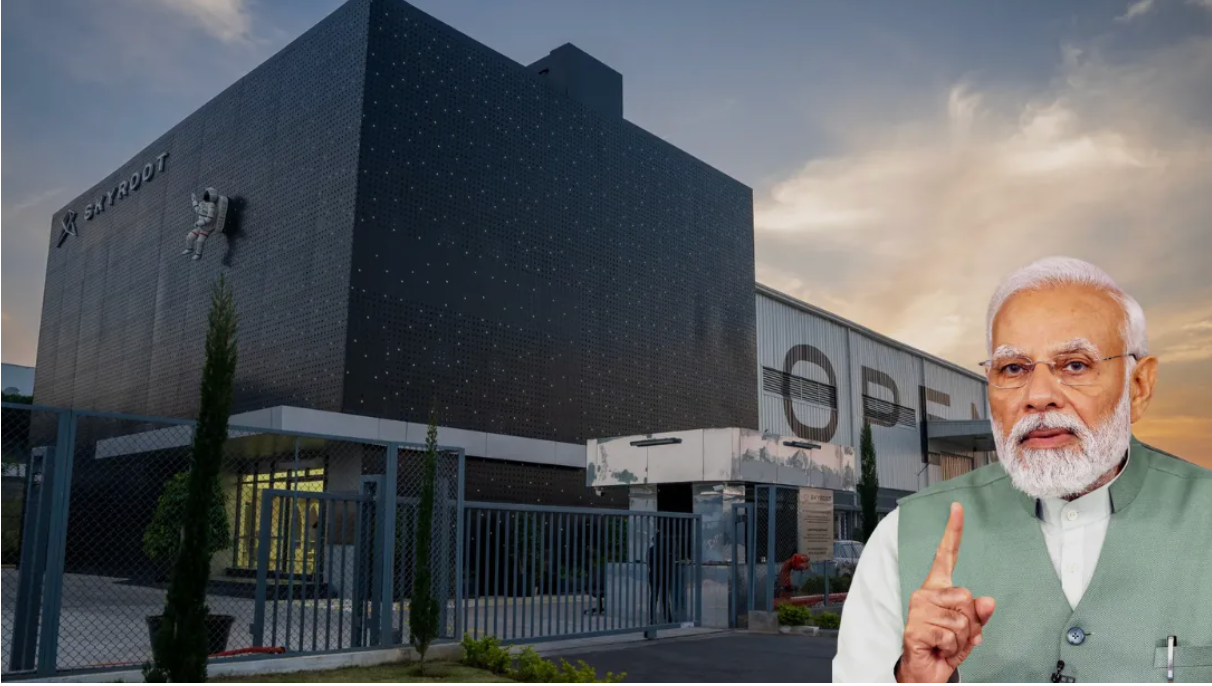
Hyderabad: The roadmap for India’s private space revolution has shifted from “Prototype” to “Production.” In a landmark event this week that will likely define the 2026 aerospace calendar, Skyroot Aerospace officially operationalized its massive new manufacturing hub, the Infinity Campus, in Hyderabad.
Inaugurated virtually by Prime Minister Narendra Modi on November 27, 2025, the facility represents the industrialization of the Indian private space sector. Alongside the campus opening, the event also saw the official unveiling of the flight-ready Vikram-1, the orbital launch vehicle that is set to become the workhorse of India’s commercial space ambitions.
For global satellite operators and domestic investors alike, the message from Hyderabad is clear: Skyroot is no longer just designing rockets; it is now ready to mass-produce them.
The “Infinity” Scale: Manufacturing One Rocket Per Month
The defining metric of the new 200,000-square-foot facility is not its size, but its throughput.
Located on the outskirts of Hyderabad, the Infinity Campus is designed with a singular, aggressive KPI: to manufacture one orbital launch vehicle every month.
This capacity is a game-changer. Until now, Indian launches were governed by ISRO’s schedule, which, while reliable, was constrained by the needs of national missions. Skyroot’s new capability aims to offer an “On-Demand” launch cadence similar to what SpaceX achieved with the Falcon 9, albeit for the small-satellite market.
“This is the factory that changes the math. We aren’t building a boutique rocket shop; we are building an assembly line. The Infinity Campus allows us to parallel-process multiple Vikram-1 stages simultaneously, slashing the turnaround time from order to orbit,” stated Pawan Kumar Chandana, Co-Founder and CEO of Skyroot Aerospace.
The facility complements the company’s existing MAX-Q headquarters (inaugurated in 2023), which focuses on design and avionics. The Infinity Campus serves as the heavy-lifting arm—handling the integration of carbon-fiber structures, solid propulsion stages, and final assembly.
Vikram-1: The “Taxi” for the Satellite Economy
The star of the inauguration was the Vikram-1, unveiled in its fully integrated flight configuration.
Unlike its predecessor, the sub-orbital Vikram-S (which flew in 2022), Vikram-1 is a true orbital vehicle. It is engineered to place payloads of up to 300 kg into Low Earth Orbit (LEO), a “sweet spot” for the booming constellation market.
Key Tech Specs of Vikram-1:
- All-Carbon-Fiber Structure: The rocket body is manufactured using high-grade carbon composites, significantly reducing weight and increasing payload efficiency.
- 3D-Printed Liquid Engines: The upper stage utilizes 3D-printed engines, which cuts manufacturing time by 80% and reduces the part count—a critical factor for the “one rocket per month” target.
- Multi-Orbit Insertion: The vehicle is capable of restarting its engine in space, allowing it to drop different satellites into different orbits in a single mission—a premium feature usually found only in much larger launch vehicles.
The 2026 Roadmap: High Frequency, Low Cost
With the Infinity Campus now live, Skyroot has set its sights on an aggressive 2026. The company is targeting the maiden orbital launch of Vikram-1 in early 2026 (Q1), followed by a rapid ramp-up in frequency.
This timing is strategic. The global small-satellite market is currently facing a “Launch Crunch.”
- The Problem: Heavy-lift vehicles (like Falcon 9) are often booked years in advance or require small satellites to wait for a primary payload (Ride-share model).
- The Skyroot Solution: With high-frequency launches, Skyroot offers a “Taxi” service where the satellite controls the schedule, rather than a “Bus” service where it must wait for others.
Solidifying India as a Global Space Hub
The operationalization of the Infinity Campus solidifies India’s position as the world’s Low-Cost, High-Reliability Space Hub.
While US-based competitors charge premium rates for dedicated launches, Skyroot aims to leverage India’s cost-efficient supply chain to offer launches at a fraction of the global price.
“Global investors are watching Hyderabad closely. If Skyroot can deliver on the monthly launch cadence in 2026, India effectively becomes the ‘Foxconn of Space Launch’—building and flying rockets faster and cheaper than anyone else,” notes a space-tech analyst from the Indian Space Association (ISpA).
The Investment Push
To fuel this industrial expansion, Skyroot has announced plans to invest an additional ₹1,000 Crore in the near future. This capital will go toward expanding the Infinity facility further and developing the next-generation Vikram-2 vehicle, which will feature reusable components.
Conclusion
As the doors of the Infinity Campus open, the “Startup Phase” of Indian space-tech effectively ends. Skyroot has graduated to the “Industrial Phase.” With a factory capable of churning out a rocket every 30 days, the sky is no longer the limit—it is just the beginning of the supply chain.